0%

Finding reliable Wholesale Denim Shirts suppliers takes more than comparing prices on a spreadsheet. In practice, fabric quality, stitching, sizing, and delivery discipline decide whether an order succeeds. A supplier may send a beautiful sample, then ship production with uneven fades or loose buttons. That gap deserves attention. Experienced buyers usually request fabric composition, denim weight, colorfastness results, size charts, and production photos before negotiating large quantities. They also inspect collar shape, sleeve seams, button strength, and shrinkage after washing. Small details become expensive returns. No checklist is perfect. I once underestimated how much a dark indigo wash could vary between batches. That mistake changed how I review swatches and approve pre-production samples.

This guide explains how to assess Wholesale Denim Shirts suppliers through practical evidence, not polished promises. Look for clear business information, responsive communication, traceable manufacturing details, and consistent quality records. Independent audits, recognized material certificates, and documented social and environmental practices can strengthen confidence. However, verify important claims with issuing organizations when possible. Ask about minimum order quantities, sample fees, lead times, packaging, defect handling, and payment terms. Reliable suppliers answer directly and record changes in writing. They should follow applicable product-safety, labor, environmental, customs, and intellectual-property requirements. A low quote can hide weak quality control or unstable capacity. Compare the total landed cost instead. Request a small trial order before scaling. It may feel slower. It is often wiser. Even careful sourcing can miss a problem, so keep inspection records and review supplier performance after every shipment.
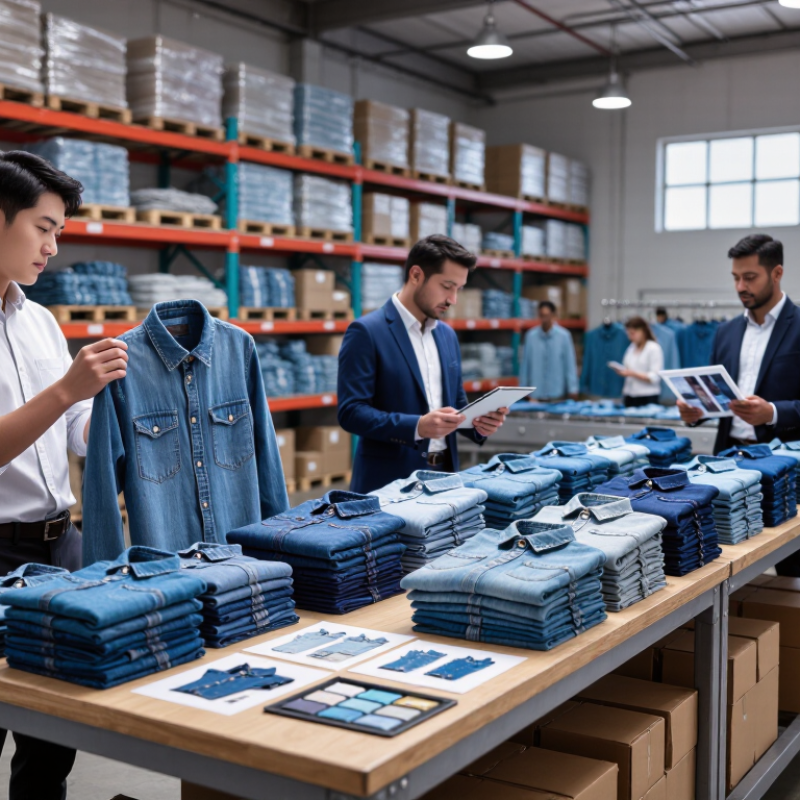
How to Find Reliable Wholesale Denim Shirts Suppliers

Defining Your Wholesale Denim Shirt Requirements

Defining your wholesale denim shirt requirements comes before contacting suppliers. Start with the customer, selling channel, and expected retail price. A workwear buyer may need rigid denim and reinforced seams. A fashion retailer may prefer softer fabric and lighter washes. Write these differences down. Vague requests create expensive revisions.

Specify fabric weight, fiber composition, color, wash effect, collar shape, cuff design, and size range. For example, request 8-ounce cotton denim, a relaxed fit, and a medium stone wash. Also define acceptable shrinkage, colorfastness, seam strength, and measurement tolerance.

Textile Exchange’s Materials Market Report 2024 states that global fiber production reached 132 million tonnes in 2023. This scale makes material traceability worth requesting, even for smaller orders. Ask suppliers for fiber documentation and test reports.

Your requirement sheet should include sample quantity, minimum order volume, packaging, lead time, and inspection timing. International Trade Centre trade data can help compare import values and product classifications across markets. Use it carefully. Denim shirt figures may include different garment types. That is an imperfect comparison. Request a pre-production sample before approving bulk work. Check the fabric under daylight, inspect button attachment, and measure the washed sample after 24 hours. Keep records. A spreadsheet is enough. Mistakes still happen. Leave room for a second fitting, because the first specification may be wrong.

Identifying Potential Denim Shirt Suppliers

Identifying Potential Denim Shirt Suppliers

Finding a reliable denim shirt supplier starts with evidence, not attractive catalog photos. Look for suppliers with clear factory details, product specifications, and consistent communication. A serious supplier should explain fabric weight, fiber content, dyeing methods, stitching standards, and available sizes. Ask for current production photos. A short factory video can also reveal cutting tables, sewing lines, and quality inspection areas.

Request samples before discussing large orders. Check the denim’s GSM, color consistency, button strength, seam alignment, and shrinkage after washing. Measure the sample against the size chart. Small differences matter. Ask about minimum order quantities, sample fees, lead times, payment terms, and replacement procedures for defective goods. Suppliers who avoid direct answers may create costly delays later. I have learned that a polished catalog does not always prove strong production control.

Tips: Contact three to five potential suppliers. Compare their replies in one spreadsheet. Ask for recent buyer references, relevant compliance documents, and a written inspection process. Verify whether the supplier owns a factory or uses subcontractors. This detail can affect quality and delivery control. Be careful with unusually low prices. They may reflect thinner fabric, rushed sewing, or unclear service terms. My own checks are not perfect, so I revisit assumptions before placing any order. A second sample sometimes exposes problems that the first review missed.

Evaluating Supplier Quality, Pricing, and Capacity

Reliable wholesale denim shirt suppliers should be judged through evidence, not polished presentations. Request fabric swatches, production samples, and recent inspection records. Check denim weight, color consistency, seam strength, button attachment, and shrinkage after washing. Touch the fabric. A stiff sample may soften later, but uneven dyeing usually signals deeper control problems.

Pricing needs a wider view than the quoted unit cost. Ask whether the price includes washing, labels, packaging, inspection, and transport preparation. Compare quotes with the same fabric weight, order quantity, and delivery terms. Numbers need context. A low price can hide higher defect rates or expensive rework. Confirm sample fees, minimum order quantities, payment stages, and the method for handling rejected goods. I would also request a written quotation with an expiry date, because cotton and energy costs can change quickly.

Capacity is not output. Ask how many sewing lines handle denim shirts, how many workers are assigned, and what monthly volume they completed recently. Review production records when possible, not only promised capacity. Check lead times during busy seasons and identify backup arrangements for fabric, washing, and packaging. A supplier may produce 20,000 pieces monthly but struggle with your size range and finishing details. That gap is easy to miss. No checklist is perfect. Allow time for a second sample, because the first one may expose construction issues that photographs never show.

How to Find Reliable Wholesale Denim Shirt Suppliers

Comparing supplier quality, pricing, and production capacity using a 100-point evaluation score

The evaluation combines common wholesale sourcing criteria: product quality consistency, price competitiveness, and production capacity. Quality is weighted at 40%, while pricing and capacity each account for 30%. Suppliers scoring above 80 are generally better positioned for reliable long-term denim shirt orders.

Verifying Certifications, Samples, and Business Credentials

When assessing wholesale denim shirt suppliers, I check documents before discussing large quantities. A valid certificate should show the issuing body, registration number, covered facility, product scope, and expiry date. Certificates can be real and still irrelevant. I verify them through the issuer’s public database or direct contact. I also compare the company name across registration records, invoices, factory addresses, and payment details. Mismatched information deserves a clear explanation.

Samples reveal what paperwork cannot. I request several sizes and wash variations, then inspect them under ordinary warehouse lighting. I measure chest width, sleeve length, fabric weight, and shrinkage after washing. I also check seam density, button attachment, colorfastness, pocket alignment, and loose threads. Ask for the actual production fabric, not a carefully selected showroom piece. Test the sample. Do not trust photographs alone.

A supplier’s business credentials should support its claims. I review operating history, production capacity, minimum order quantities, lead times, and verifiable trade references. A live factory call can confirm equipment, workers, storage, and current output, although it is not a complete audit. Independent inspections add useful evidence before shipment. I once treated a polished sample as proof of stable quality; that judgment was too optimistic. Bulk production exposed uneven sizing. Now I request a written specification sheet, a pre-production sample, and agreed inspection criteria. Leave room for questions. Reliable sourcing is careful, sometimes slow, and never based on one impressive document.

Comparing Terms and Selecting the Right Supplier

Finding a reliable wholesale denim shirt supplier starts with comparing terms, not attractive photos. A polished catalog can hide inconsistent sizing or weak stitching. Request a physical sample before discussing large quantities. Check fabric weight, seam strength, button attachment, color consistency, and shrinkage after washing.

Compare minimum order quantities, sample fees, production time, payment schedules, and shipping responsibilities. Ask whether prices include packaging, labeling, or quality inspections. A low unit price may become expensive when rework, delays, or damaged cartons appear. Clear written terms reduce confusion, especially when custom measurements or washes are involved. I have learned that fast replies do not always indicate strong production control. That assumption can be costly.

Tips: Build a simple comparison sheet. Record every quote, revision, and promised date. Ask suppliers to explain their inspection process and provide recent production photos. Confirm how they handle defective shirts, late delivery, and measurement differences. Keep a small trial order before scaling. It may feel slower, but it reveals problems early. Do not ignore uneasy details. A supplier who avoids direct answers may create larger problems later. Reliable cooperation depends on evidence, consistent communication, and terms both sides can realistically follow.

How to Find Reliable Wholesale Denim Shirts Suppliers - Comparing Terms and Selecting the Right Supplier

Typical wholesale terms for denim shirt suppliers. Actual terms vary by fabric, order volume, customization, destination, and seasonal capacity.
Supplier Profile Best Fit Typical MOQ Sample Lead Time Bulk Production Lead Time Customization Common Payment Terms Common Incoterms Quality Evidence to Request Reliability Consideration
Profile A: Small-batch workshop New brands and test launches 50–150 pieces per style 7–14 days 25–40 days Basic color, label, button, and packaging changes 30% deposit; 70% before shipment EXW or FOB Size chart, fabric composition, pre-production sample, inspection photos Flexible but may have limited production capacity during peak periods
Profile B: Mid-size export factory Growing retailers with repeat orders 300–800 pieces per style 10–18 days 35–55 days Full private-label development and several wash options 30% deposit; balance against inspection or shipping documents FOB, CIF, or FCA Factory audit, test reports, inline inspection records, corrective-action reports Usually offers a stronger balance of cost, capacity, and communication
Profile C: Large-volume manufacturer Established chains and high-volume programs 1,000–3,000+ pieces per style 14–21 days 45–75 days Advanced washes, grading, packaging, and production planning 20%–30% deposit; balance before shipment or under agreed credit terms FOB, CIF, or DDP by quotation Social-compliance audit, fabric test reports, needle policy, final inspection report Competitive unit pricing, but less suitable for low-volume orders
Profile D: Sustainable-focused supplier Brands requiring traceability and material claims 300–1,000 pieces per style 12–21 days 40–65 days Organic or recycled-fiber options, low-impact washing, custom trims 30% deposit; 70% before shipment FOB or CIF Valid certification scope, transaction certificates, chemical-management records, traceability documents Confirm that sustainability certificates cover the specific facility and order
Profile E: Trading and sourcing office Buyers needing multi-factory sourcing support 100–500 pieces per style 10–20 days 35–60 days Design adaptation, supplier coordination, labels, and consolidation 30% deposit; balance before shipment FOB, CIF, or DDP Disclosure of manufacturing location, commercial invoice, inspection report, and subcontractor details Convenient service, but verify who controls production and quality decisions
Profile F: Ready-stock wholesaler Fast replenishment and standard designs 20–100 pieces per color or style Usually not required; stock can ship in 3–10 days Not applicable unless replenishment is arranged Limited to labels, packing, and selected color quantities Full payment or 50% deposit for reserved stock EXW, FCA, or DDP Current stock photos, measurement chart, fabric composition, defect and return policy Quick delivery, but limited control over fit, wash consistency, and future availability
Selection checklist: Compare landed cost rather than unit price alone, approve a measured pre-production sample, define acceptable quality limits, verify certificates independently, confirm production capacity, and use a documented inspection process before final payment.

FAQS

What details should I define before contacting a wholesale denim shirt supplier?

Define the target customer, sales channel, retail price, fabric weight, fiber content, color, wash, collar, cuffs, and size range. Vague requests cause costly revisions.

How can I describe a denim shirt requirement clearly?

Give measurable details, such as 8-ounce cotton denim, relaxed fit, medium stone wash, and defined measurement tolerance. Specific examples reduce misunderstandings.

Which quality standards should appear in the requirement sheet?

Include acceptable shrinkage, colorfastness, seam strength, button attachment, and measurement tolerance. Write every limit down.

Why should I request material traceability documents?

Large-scale fiber production makes traceability important, even for smaller orders. Request fiber records and relevant test reports from the supplier.

What should I check in a pre-production sample?

Inspect the fabric in daylight, measure the washed shirt after 24 hours, and check buttons, seams, pockets, sleeves, and loose threads. Photos are not enough.

How many sample versions should I request?

Request several sizes and wash variations using the actual production fabric. A showroom sample may hide bulk-production problems.

How can I verify a supplier’s certificates?

Check the issuing body, registration number, facility, product scope, and expiry date. Verify the document through a public database or direct contact.

What business information should match across supplier documents?

Compare the company name, registration records, invoices, factory address, and payment details. Any mismatch needs a clear explanation.

Can a live factory call prove reliable production?

A live call may show equipment, workers, storage, and current output. It is useful evidence, but not a complete audit.

What should I do before approving bulk production?

Confirm the written specification, approve a pre-production sample, define inspection criteria, and leave time for a second fitting. My first judgment once failed; a polished sample hid uneven sizing.

Conclusion

Finding reliable Wholesale Denim Shirts suppliers begins with clearly defining your product requirements, including fabric composition, denim weight, colors, sizes, styles, order quantities, target prices, and customization needs. A detailed specification helps you identify suitable suppliers and communicate expectations efficiently. Potential suppliers can be found through industry networks, trade exhibitions, sourcing platforms, and professional referrals. Shortlist companies with relevant manufacturing experience, stable production resources, and a proven ability to serve wholesale customers.

Before making a decision, evaluate each supplier’s product quality, pricing structure, production capacity, lead times, and communication. Request samples to inspect stitching, fabric durability, sizing consistency, washing effects, and finishing details. You should also verify business credentials, quality certifications, factory information, and compliance documentation where applicable. Finally, compare minimum order quantities, payment terms, shipping arrangements, return policies, and after-sales support. Choosing the right supplier means balancing quality, reliability, cost, flexibility, and long-term cooperation potential rather than focusing only on the lowest price.

Elowen

Elowen

Elowen is a professional marketing specialist dedicated to helping businesses understand how thoughtful products, clear communication, and reliable service can create lasting value. With a deep knowledge of the company’s solutions, Elowen regularly contributes insightful articles to the corporate......