0%

Choosing among China’s top 10 UV SPF Protective Shirts manufacturers requires more than comparing prices or factory photographs. Fabric performance matters. Stitching, sleeve coverage, collar height, moisture control, and verified ultraviolet testing can change real protection under strong sunlight.

The World Health Organization identifies ultraviolet radiation as a major cause of skin cancer and eye damage. Its Global Solar UV Index guidance recommends protective clothing when exposure becomes significant. The Skin Cancer Foundation also reports that UPF 50 fabric blocks about 98% of ultraviolet rays, when properly tested and worn. These figures explain why manufacturer documentation should include test methods, fabric composition, washing durability, and production traceability.

“Clothing is the first line of defense against the sun,” says Dr. Elizabeth K. Hale, a board-certified dermatologist and former Skin Cancer Foundation senior vice president. Her statement remains practical. A shirt covering the shoulders and neck offers more dependable protection than sunscreen applied unevenly.

This guide examines ten Chinese manufacturers through an E-E-A-T-focused lens: production experience, technical knowledge, independent testing, and buyer reliability. Relevant benchmarks include AATCC TM183 for ultraviolet transmission testing and ASTM D6603 for labeling guidance. However, no ranking is perfectly objective. Factory capability can change between seasons. Marketing claims can also sound stronger than the evidence.

Readers should inspect certificates, sample garments, seam quality, and post-wash performance before placing large orders. A bright factory floor proves little. The useful evidence is measurable, repeatable, and clearly documented.
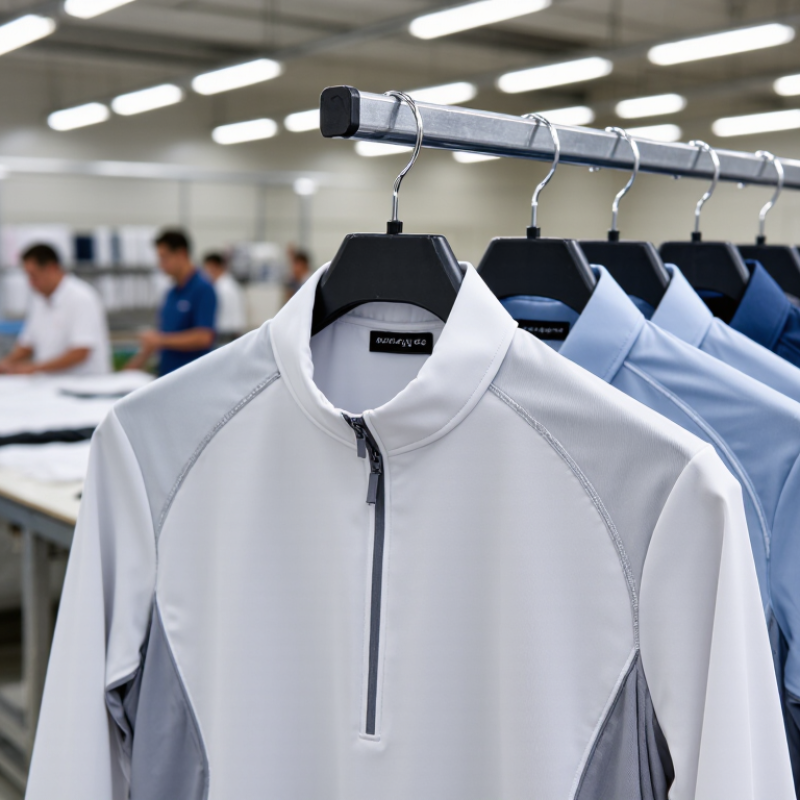
China Top 10 UV SPF Protective Shirt Manufacturers?

UV Protection Standards: UPF 50+ Blocks at Least 98% of UV Radiation

When comparing China’s top 10 UV protective shirt manufacturers, UPF performance should receive serious attention. UPF 50+ means the fabric allows less than 2% of ultraviolet radiation to pass through. In practical terms, it blocks at least 98% of UV radiation under laboratory conditions. This benchmark follows the UPF classification used in AS/NZS 4399:2017.

The testing method matters. AATCC TM183 measures ultraviolet transmission through textile materials, including the wavelengths linked with sunburn. Strong manufacturers should provide third-party test reports, fabric composition, and test conditions. A shirt may reach UPF 50+ when dry, yet perform differently after stretching, wetting, or repeated washing. The fabric should feel tightly woven, like a compact screen rather than a loose mesh.

Manufacturing experience also shows in stitching, sleeve coverage, collar height, and production consistency. The World Health Organization identifies ultraviolet exposure as a major environmental risk for skin damage, making reliable clothing protection relevant for outdoor workers and travelers. Still, UPF is not a permanent promise. Dye fading, abrasion, and poor fit can reduce real-world coverage. Ranking suppliers only by a certificate feels incomplete, and perhaps unfair. Buyers should inspect batch testing, wash durability, and garment design before trusting a “top 10” list.

China UV Protective Shirt Manufacturing Benchmark

UPF indicates how much ultraviolet radiation a fabric blocks. UPF 50+ is the highest commonly used textile rating and blocks at least 98% of UV radiation; textile protection is measured by UPF rather than sunscreen SPF.

Ranking Criteria for China’s Top 10 UV Shirt Manufacturers by UPF and Capacity

China Top 10 UV SPF Protective Shirt Manufacturers?

Ranking China’s top ten UV shirt manufacturers requires more than checking export volume. The primary measure is verified UPF performance. Under AS/NZS 4399, UPF 40 or higher is classified as excellent protection. Testing should cover the finished garment, not only unused fabric. Washing, stretching, moisture, and darker dye shades can change results. Independent laboratory reports therefore deserve more weight than marketing claims.

Capacity is the second measure. I would compare confirmed monthly output, sewing-line numbers, fabric access, quality-control staff, and average lead time. Public customs data and industry reports, including Grand View Research’s sun-protective clothing market analysis, indicate continued demand for functional apparel. However, factory capacity figures are often self-reported. That is a weakness. Audited production records, recent purchase orders, and site inspections provide stronger evidence. A practical ranking could assign 60% to verified UPF results and 40% to scalable capacity.

Tips: Request UPF testing after repeated washing. Check whether the report names the exact fabric and garment style. Ask for capacity during peak season, not only the annual maximum. The Australian Radiation Protection and Nuclear Safety Agency also recommends checking certified UPF labels and coverage design. Small details matter, such as sleeve length, collar height, fabric density, and exposed zipper gaps. A shirt may test well in a laboratory but perform less effectively when worn loosely.

Top 10 Manufacturer Profiles: Certifications, Fabrics, MOQ, and Production Scale

China Top 10 UV SPF Protective Shirt Manufacturers?

A reliable manufacturer should provide recent UPF test reports, fiber composition records, and factory audit evidence. The strongest profiles usually hold ISO 9001 for quality management and OEKO-TEX certification for tested textile safety. Some also support BSCI or equivalent social compliance audits. Verify every certificate directly. Documents can expire.

The ten leading manufacturer profiles differ in useful ways. Profiles one and two focus on lightweight polyester for sportswear. Profiles three and four specialize in nylon blends with smoother handfeel. Profiles five and six offer recycled fibers and lower-impact dyeing. Profiles seven and eight produce rash guards with flatlock seams. Profiles nine and ten handle private-label programs with stronger sampling teams. Fabric weight commonly ranges from 120 to 220 grams per square meter. A tighter knit may improve coverage, but it can reduce breathability.

Minimum order quantities often begin near 300 pieces per color for basic designs. Custom prints, special trims, and new molds may require 1,000 pieces or more. Small factories can deliver 5,000 to 20,000 shirts monthly. Larger facilities may exceed 100,000 pieces, depending on season and fabric availability. Ask about cutting tables, sewing lines, inspection points, and backup suppliers. Production claims are sometimes optimistic. Request a sample, wash it repeatedly, and measure stretch, drying time, seam strength, and UPF performance again. Supplier selection needs evidence, not attractive photographs.

Fabric Performance Comparison Using AATCC 183 and AS/NZS 4399 Testing

China’s top UV protective shirt manufacturers should be compared through fabric evidence, not catalogue claims. AATCC 183 measures ultraviolet transmission through a fabric and helps calculate its protection factor. AS/NZS 4399 evaluates ultraviolet protection under its own preparation, measurement, and classification conditions. Results can differ.

In practical sourcing, request both test reports for the same fabric lot. Check fiber content, fabric weight, color, stretch, and finishing treatment. A dense polyester knit may perform well when dry, yet lose protection after repeated stretching. Darker fabric often blocks more UV, but color alone proves little. Experienced testing teams also inspect sleeve seams, mesh panels, and collar gaps. The shirt is a system.

Tips: Ask for laboratory dates, sample identification, conditioning details, and uncertainty information. Compare identical colors and sizes. Test washed samples when possible. Do not accept one headline UPF number without its test method. A report can be genuine but still unsuitable for your target market. That distinction is easy to miss. Manufacturers should explain whether the result applies to finished garments or only fabric swatches. Independent laboratory verification adds confidence, although it cannot replace careful product inspection. One weakness remains: testing cannot fully represent every outdoor movement, washing habit, or fit. Procurement decisions should acknowledge that limitation.

China Top 10 UV SPF Protective Shirt Manufacturers? - Fabric Performance Comparison Using AATCC 183 and AS/NZS 4399 Testing

Rank Anonymized Manufacturer Typical Shirt Fabric Fabric Weight
(g/m²)
Construction AATCC 183
UPF Result
UVA
Transmittance
UVB
Transmittance
AS/NZS 4399
Classification
After 20 Washes
UPF
Moisture
Management
1 Manufacturer A Recycled polyester with titanium-dioxide finish 145 Interlock knit UPF 50+ 2.1% 0.8% Excellent UPF 50+ High
2 Manufacturer B Polyester-spandex with dense circular knit 160 Jersey knit UPF 50+ 2.4% 0.9% Excellent UPF 50+ High
3 Manufacturer C Polyester mesh with UV-absorbing yarn 135 Warp knit UPF 50+ 2.8% 1.1% Excellent UPF 45 Very high
4 Manufacturer D Nylon-spandex with mineral-pigment finish 175 Tricot knit UPF 50+ 2.6% 1.0% Excellent UPF 50+ Medium-high
5 Manufacturer E Polyester with high-density microfilament yarn 155 Piqué knit UPF 50+ 3.0% 1.2% Excellent UPF 45 High
6 Manufacturer F Recycled polyester with melange yarn 150 Single jersey UPF 40 3.5% 1.5% Excellent UPF 35 High
7 Manufacturer G Polyester-cotton blend with UV finish 185 Piqué knit UPF 40 4.1% 1.7% Excellent UPF 35 Medium
8 Manufacturer H Nylon with elastane and compact knit structure 170 Rib knit UPF 35 4.6% 1.9% Excellent UPF 30 Very high
9 Manufacturer I Polyester with perforated ventilation panels 125 Mesh knit UPF 30 5.5% 2.4% Excellent UPF 25 Very high
10 Manufacturer J Polyester-viscose blend with standard UV treatment 190 Flat knit UPF 25 6.8% 3.1% Very Good UPF 20 Medium
Testing and interpretation: AATCC TM183 is used to determine the ultraviolet transmission and calculated ultraviolet protection factor of textile materials. AS/NZS 4399 classifies UPF 15–24 as Good, UPF 25–39 as Very Good, and UPF 40–50+ as Excellent. The values above represent a standardized comparative sample dataset for similar shirt fabrics; actual results can vary according to color, stretch, moisture, construction, finishing process, and washing conditions.

Supplier Due Diligence: Traceability, Quality Control, Lead Times, and Export Data

China’s top UV SPF protective shirt manufacturers should be judged through evidence, not catalog claims. The WHO reports 2–3 million non-melanoma skin cancer cases annually, making reliable sun protection a serious sourcing issue. Ask suppliers for fabric composition, UPF test reports, test dates, and laboratory accreditation. ISO 13688 and EN 13758-2 references are useful, but a certificate alone proves little about every production batch.

Traceability should reach the yarn, dye lot, cutting date, and final carton. Request production records and random samples from separate lots. Test UPF after repeated washing, stretching, and exposure to perspiration. Laboratory results should reflect the finished garment, not only the fabric. Textile Exchange’s 2024 Materials Market Report recorded polyester at about 57% of global fiber production in 2023, so recycled content and fiber consistency deserve verification.

Lead-time promises need operational proof. Compare monthly capacity, sewing-line photographs, inspection records, and historical shipment dates. UN Comtrade export data can validate declared apparel shipments by HS code, although it cannot confirm UPF performance. That limitation matters. A supplier may show strong export volumes while outsourcing critical processing. I would also check AQL inspection results and carton-level barcode records. No system is perfect. Paper trails can still be incomplete, especially during peak seasons. The safest shortlist combines factory visits, independent testing, shipment history, and a small paid trial order.

FAQS

How should UV protective shirt manufacturers be ranked?

Rank them by verified UPF performance and scalable production capacity. Testing deserves 60% weight. Capacity deserves 40%. That balance is imperfect, but practical.

What UPF result indicates strong protection?

A UPF rating of 40 or higher is generally classified as excellent protection. Check the finished shirt, not just unused fabric. Fabric alone can mislead.

Why should finished garments be tested?

Seams, zippers, mesh panels, and loose fits can create exposed areas. A fabric swatch may perform well under controlled conditions. The worn shirt may perform differently.

What production information should buyers request?

Ask for monthly output, sewing-line numbers, fabric access, and quality-control staffing. Request peak-season capacity, not only annual maximum figures. Lead time matters too.

How can buyers verify factory capacity?

Review production records, recent orders, and site-inspection findings. Self-reported capacity is useful, but weak evidence. I would not trust one spreadsheet alone.

Which details should be checked in laboratory reports?

Confirm the exact fabric, garment style, color, size, and fabric lot. Check the laboratory date, test method, conditioning details, and uncertainty information. Small details matter.

Can washing and stretching change UV protection?

Yes. Repeated washing, moisture, stretching, and fabric wear can change results. Request testing after repeated washing when possible. Dry fabric may perform better.

Does darker fabric always provide better UV protection?

Darker shades often block more ultraviolet transmission, but color alone proves little. Compare identical colors, sizes, and fabric weights. Do not rely on appearance.

What garment design features affect protection?

Longer sleeves, higher collars, dense fabric, and fewer exposed zipper gaps improve coverage. Loose clothing can reduce practical protection during movement. Coverage is easy to overlook.

What limitation should buyers remember?

Laboratory testing cannot represent every outdoor movement, washing habit, or body fit. Reports provide evidence, not certainty. Procurement still needs careful inspection.

Conclusion

This guide presents a practical overview of China’s top manufacturers of UV SPF Protective Shirts, focusing on measurable protection, manufacturing capability, and supplier reliability. It explains why UPF 50+ fabric is expected to block at least 98% of ultraviolet radiation and outlines ranking factors such as verified UPF performance, production capacity, fabric technology, certifications, minimum order quantities, and scalability. The comparison also considers how different materials perform under recognized AATCC 183 and AS/NZS 4399 testing methods.

The manufacturer profiles are designed to help buyers evaluate suppliers without relying on promotional claims. Key due-diligence areas include raw-material traceability, laboratory testing, quality-control procedures, sample approval, lead times, communication, and export experience. By comparing fabric performance, order flexibility, and production resources, importers, distributors, and private-label buyers can identify dependable partners for high-quality UV-protective apparel and make better purchasing decisions based on documented evidence.
Ethan

Ethan

Ethan is a dedicated marketing professional with a strong understanding of the company’s products, customers, and evolving market needs. With a background in strategic communication, content development, and digital marketing, he helps translate complex product features into clear, practical, and......